

A water softener trades the hardness minerals in your water for sodium. The trade is called ion exchange, and it happens in a tank full of tiny resin beads. The softener uses salt to recharge those beads so it can keep trading for years.
Below, we walk through what happens inside the tank, where the salt goes, and what care a water softener needs.
What a Water Softener Does to Your Water
Hard water has calcium and magnesium dissolved in it. Those minerals leave scale on your faucets and spots on your glasses. For a side-by-side look, read our post on the difference between hard water and soft water.
A water softener takes those minerals out by swapping them for sodium. It treats the water for your whole house, so every tap, shower, and appliance gets soft water.
How a Water Softener Works, Step by Step
Here is what happens to the water on its way to your tap:
- Hard water enters the resin tank. Water from your well or city line flows into a tank packed with resin beads that look like wet sand.
- The beads swap sodium for hardness minerals. The beads carry a negative charge, so they hold on to positively charged ions, and they start out loaded with sodium. Calcium and magnesium each carry two positive charges, and sodium carries only one. The beads hold the stronger charge tighter, so as hard water flows past, calcium and magnesium take sodium’s place and the sodium goes into the water.
- Soft water goes to your taps. The water leaves the tank without the hardness minerals and flows to every tap in the house.
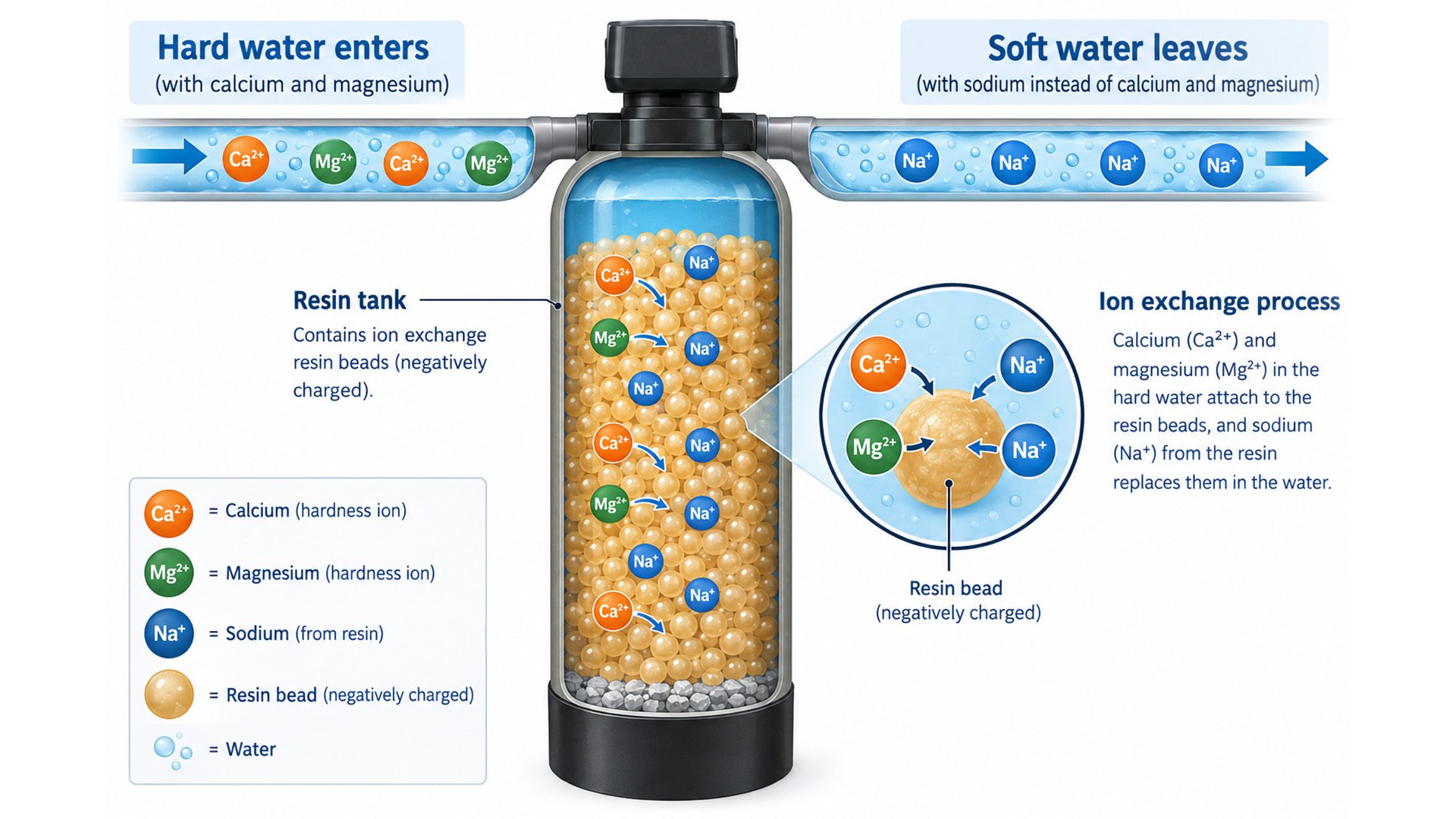
The beads can hold only so many minerals, like a parking lot with a limited number of spaces. Before every space fills up, the water softener runs a recharge to empty them.
How the Salt Recharges the Resin (and Where It Goes)
The recharge runs on salt. The salt sits in the brine tank where it dissolves in water and turns into brine, a very salty liquid. When the beads run low on sodium, the softener flushes that brine through the resin tank. Brine is packed with sodium, and that much sodium forces the calcium and magnesium off the beads. The beads pick sodium back up and are ready to trade again.
The minerals have to go somewhere, and so does the brine. The spent brine, carrying the minerals it pulled off the beads, goes down the drain. Most automatic water softeners recharge in the middle of the night, so you rarely see it happen.
Each recharge uses salt, which is why a softener keeps needing refills. When the brine tank runs out of salt, it can’t recharge.
The Three Main Parts of a Water Softener
Every water softener has three main parts:
- Resin tank: holds the beads where the trade happens.
- Brine tank: holds the salt and the water that turns it into brine. It is the one you pour salt into.
- Control valve: runs the recharge.
Water softeners also come in single-tank and two-tank setups. A single-tank water softener pauses the water supply while it recharges. A two-tank water softener alternates between its tanks, so soft water keeps flowing. The trade works the same either way.
What a Water Softener Doesn’t Do
A water softener removes hardness minerals. Chlorine and other things in your water need a different tool, like a whole-home filtration system. The full list is in our guide on what a water softener removes and what it doesn’t.
What Care Does a Water Softener Need?
Keep the brine tank stocked with salt and have the system checked once a year. Our salt delivery service handles the salt, and our maintenance and service team handles the checkups on any brand of water softener.
Frequently Asked Questions
What is the downside of a water softener?
Two things come with a water softener. The swap adds sodium to your water, and how much depends on how hard your water was to start with. If you are on a sodium-restricted diet, ask your doctor. The second is salt refills, and a salt delivery schedule takes the heavy lifting off your hands.
Can I use water while my water softener is recharging?
A single-tank water softener pauses the water supply during a recharge, and a two-tank water softener keeps water flowing. Most recharges run in the middle of the night, so most households never run into it.
Ready to Soften Your Water?
Mid-Mo Water Solutions installs water softeners for homes in Jefferson City, Columbia, Lake of the Ozarks, and the surrounding mid-Missouri communities. Contact Mid-Mo Water Solutions and we’ll help you choose the softener that fits your home and your water.